



Coach Foundation passed ten million dollars in cumulative revenue before it ever ran an ad. Sai Blackbyrn says most of that came from other people endorsing the business to their audiences.
He is specific about how it worked. Three rules sit underneath all of it, and every tactic he describes is one of those three applied to a different problem.
What follows is how a partnership marketing strategy works in practice, and what carries over to a membership, association or eLearning business that already has an audience and a network worth trading on.

What a Partnership Actually Is
Start with the definition, because the word covers a lot of ground.
“It's somebody that's gonna be endorsing and promoting what you do.”
Someone runs a webinar to their list, sells your product on the back end, and takes a commission on every sale. They supply the traffic, you do the selling, and you pay out of revenue that already happened.
Set that against paid acquisition. An ad budget is money you commit before you find out whether the offer and the creative work together. A partnership costs you nothing until a sale exists.
The traffic behaves differently too. See an ad for a film and you might go. Have a friend tell you it's worth seeing and you probably will. A partnership runs on the second mechanism at scale, with one person vouching for you to their whole list at once.
Before this reads as an argument against advertising: Coach Foundation spends millions on ads today. The company only started buying traffic once it had partnered with most of the people in its space.
The Formula: Three Rules
“There is no specific script, but there is a specific formula.”
Sai returns to the same three rules:
Choose carefully. Selection does most of the work, because it removes the relationships that absorb effort and return nothing.
Treat the relationship as one hundred percent yours. He doesn't need the other person to follow up, invite him to things, or pay for dinner. Maintenance is his job and none of it is theirs.
Provide value continuously, for free, over a long period. Not as a trade for something specific, but as the default way he operates.
Underneath all three is something he worked out long before the business existed:
“I didn't have to be impressive. I just had to be impressed. I didn't have to be interesting, I had to be interested.”
That changes what you do on a first call. You stop pitching and start looking for something you can do for them.
The Move That Scaled It: Ask for Three, Offer Three
Cold outreach worked, barely. Of roughly five hundred attempts in the early days, Sai reckons about seven went anywhere. Introductions he never asked for went differently. Around eight in ten of them turned into someone promoting Coach Foundation.
So he rebuilt the ask around introductions.
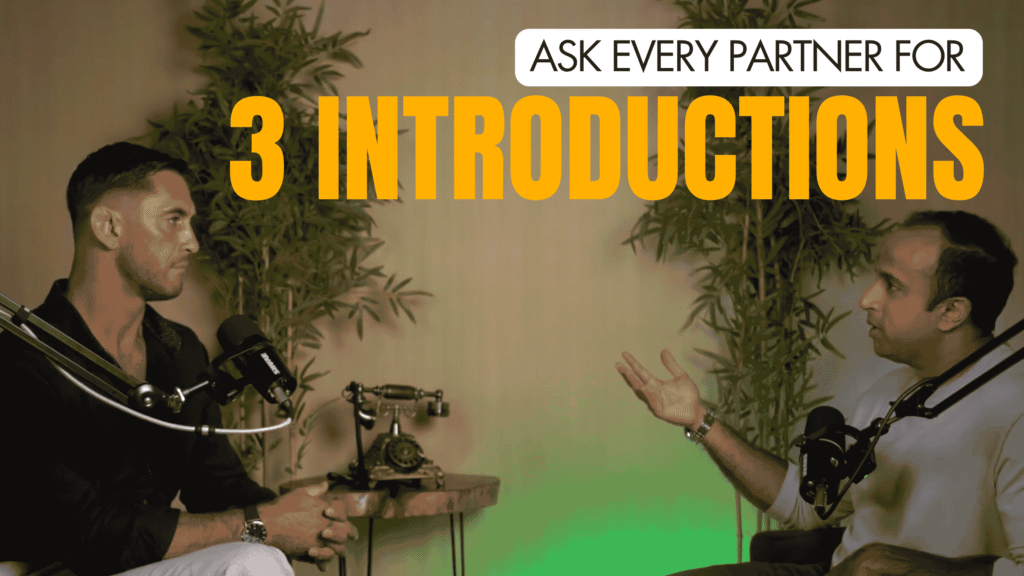
At the end of a call, he would mention that he knew a few people who might be useful to them, and propose a swap. Three introductions each way. Three, because it is a small ask: “Everybody else knows three people in their space that's relevant.” And because the other person gets the same thing back, it doesn't read as a favor.
The first person said yes. Two of those three introductions closed, by his count, and in those conversations he made the same offer again. That is where the compounding comes from. Three became nine, then twenty-seven, and over the years the network passed two hundred people, more than a hundred of whom actively promoted the business.
He is firm about the sequence. The ask goes at the end, after the rest of the conversation has done its work. Out of order, he says, the power dynamic on the call shifts.
All of it rests on one observation: “We may not know everybody, but everybody else knows everybody.” Which also means a partner who sends you no revenue can still be worth keeping. Who they can introduce you to is a separate question from what they can sell for you.
Variations on the Same Three Rules
Once the swap worked, Sai applied the same structure to other problems.
Endorsements from well-known people were hard to get, so he proposed endorsement swaps: he endorses them, they endorse him. He separates a testimonial from an endorsement. A testimonial says you worked for them and produced a result. An endorsement says this person is worth your time. By his estimate an endorsement is still about eighty percent as effective.
Backlinks were the same problem in a different form, so he ran blog swaps. He would write a piece for a partner's site, they would write one for his. It worked, and Google traffic climbed past a million hits a year. It has since fallen to a fraction of that, which he puts down to AI search rather than anything about the swap itself.
Follow-Up Is Most of the Job
Sai was born and raised in England, where he says the cultural reading is that if somebody doesn't respond to you, that is the response, and it means no.
His own experience says otherwise. In all his years of doing this, one person eventually told him they had assumed he would take the hint, and that came after twenty follow-ups. For everyone else the reason had nothing to do with him: life got in the way, family got in the way. Some answered after seven months. One coaching organization ghosted him for two years before saying yes.
When someone introduced by a third party goes quiet, he has a specific move. Start a thread and loop in the person who made the introduction. He calls it social pressure.
The system behind it is a spreadsheet and scheduled follow-ups. A partnerships manager came later, and he still handles the significant relationships himself.
On pace: “It took me a month to get the first one, but then it took me six months to get the fortieth.” It wasn't evenly distributed, he says. It was an exponential curve.
Who to Pick as a Partner
Two criteria, and the second can override the first.
The first is revenue, specifically not profit. Revenue reflects what someone spends to get in front of their audience, which makes it a rough proxy for reach. Below somewhere around a million to a million and a half a year, Sai's experience is that the work doesn't pay back, for two reasons he names: people at that level tend to know other people at that level, and an endorsement from them won't carry much weight.
The second is how well connected they are, and it can negate the first. Someone with no revenue who knows everybody may still be worth the effort. His example is the person who does the editing at a studio and deals with everyone who films there. Not a decision-maker, but in contact with all of them.
Where to Start a Partnership Marketing Strategy
His practical answer is a list, and it isn't LinkedIn. LinkedIn is full of people you don't actually know, and an introduction only counts for something if the person making it actually knows you.
Go through the messaging app you actually use, iMessage or WhatsApp. Those are people who know you well enough for an introduction from them to mean something. Thirty minutes gives you a working list of around forty names, he says, and you can't hand the job to AI, because AI doesn't know who you know. Reach out to those forty, get into conversations, ask them to introduce you, and his estimate is that the forty becomes about two hundred inside three months.
Then there is an exercise he gave one of his clients, which he rates as one of the most powerful things you can do. A coffee shop, a notepad, and none of the devices: no phone, no laptop, no watch. One question written at the top of the page, and two hours to sit with it.
Who has my audience?
The first half hour is uncomfortable and produces almost nothing. His client came out of the two hours with fifty names, and exactly one of them arrived in that first thirty minutes. The other forty-nine came once there was nothing else to do but look at the question.
The Caveat He Insists On
Asked what a business doing a couple of million a year should do first, Sai questioned the premise before answering it. If your ads are working, he says, this is probably a waste of your time, because ads scale higher than partnerships do.
He added a qualification that matters just as much. Partnerships don't have to drive traffic. They can drive endorsements, and endorsements from well-known people lift conversion rates on paid ads. Run both and they compound.
The B2B Shape Is Different
Sai sells to a mass-market audience, and a partner there endorses him to ten thousand people at once. B2B doesn't work that way, and he is clear about why the difference matters.
B2B sales cycles are long. What shortens them is trust and likability, and an introduction supplies both before the first conversation happens. Where the ticket size runs into the hundreds of thousands a year, a partner isn't going to send you a list. They are going to introduce you to one person, and it will be the person who can sign.
He calls that kind of introduction, straight to the decision-maker at a company you want, the real payoff in B2B.
What Membership and eLearning Operators Can Take From This
Sai sells to coaches, and his tactics are built for a mass-market audience. The mechanics underneath them are what transfer.
Depth changes what a partner sends you. Placement doesn't. A listing in a platform's partner directory, an association's sponsor page or a resource roundup is a placement. It produces whatever the host decides to send, and you have no input into it. A joint webinar, a piece of content made together, or a member-only offer with commission attached changes which provider gets favored when the host has a choice. Two or three relationships is the whole exercise. You are not trying to deepen all of them.
If the ask reads as a favor, the structure is wrong. This is the engine underneath every tactic above. Three introductions for three introductions. An endorsement for an endorsement. A post on their site for a post on yours. When Sai couldn't reciprocate in kind, he changed the currency rather than shrinking the ask, and a revenue share turned a no into a yes at the same fee. Before you send an ask, work out what sits on the other side of it. If nothing does, you are asking for a favor, and favors don't scale.
Score a partner on who they reach, not on whether they would buy from you. This is what changes your list. The association staffer who runs the member newsletter, the community manager at a platform you integrate with, the consultant who sets up three new memberships a year: none of them are prospects, and all of them sit in front of people who are. Revenue is the proxy Sai uses for reach, with an override for anyone unusually well connected. His own screen is worth noting: he doesn't work with businesses under roughly a million to a million and a half a year, and much of our audience sits in or above that range.
In B2B, expect one introduction rather than a mass promotion. A partner with a mass-market audience endorses you to ten thousand people. A partner in a high-ticket B2B market introduces you to the one person who can sign. Both are partnerships, and only the first one looks like marketing. If you sell into associations, enterprises or institutions and you measure a partnership by traffic, you will conclude it failed while it is working.
Sai's last point is that there is a person on the other end, not a computer. A partnership marketing strategy only pays out after you have been useful to them for a while. He says he is still shocked at how many people skip it.
Sai Blackbyrn is the founder of Coach Foundation. You can find him at https://coachfoundation.com/ and linkedin.com/in/sai-blackbyrn
Running a Membership or eLearning Platform on WordPress?
MemberFix provides managed WordPress operations for membership, eLearning, and community platforms — so your team never has to worry about the tech breaking during a launch or losing members to site issues. We handle development, support, updates, and monitoring with SLA-backed guarantees. Trusted by industry leaders like Echelon Front, TechServe Alliance, and hundreds of others since 2014.
About MemberFix Radio:
We interview experts and share insights for membership site owners and subscription business leaders building sustainable, profitable recurring revenue models.