Who: Therapist Resource Institute (TRI), a membership community for licensed therapists across the United States. WordPress, running MemberPress and BuddyBoss.
Problem: TRI's Referral Desk lets therapists pass on clients they can't take, so it needs enough therapists taking part. Only paying members had access, and paid membership grew slowly after the initial launch, as expected for a new community.
Result: Around 40 free members in six weeks, three of them now on paid plans, plus the first group subscription.
Scope: A free membership level, the referral flow it opens, a referral dashboard and a group plan, built on the MemberPress and BuddyBoss setup already in place.
Therapist Resource Institute, a membership community for licensed therapists in the US, needed more therapists on the platform. MemberFix built the freemium membership site tier and the features around it as a custom MemberPress development project.
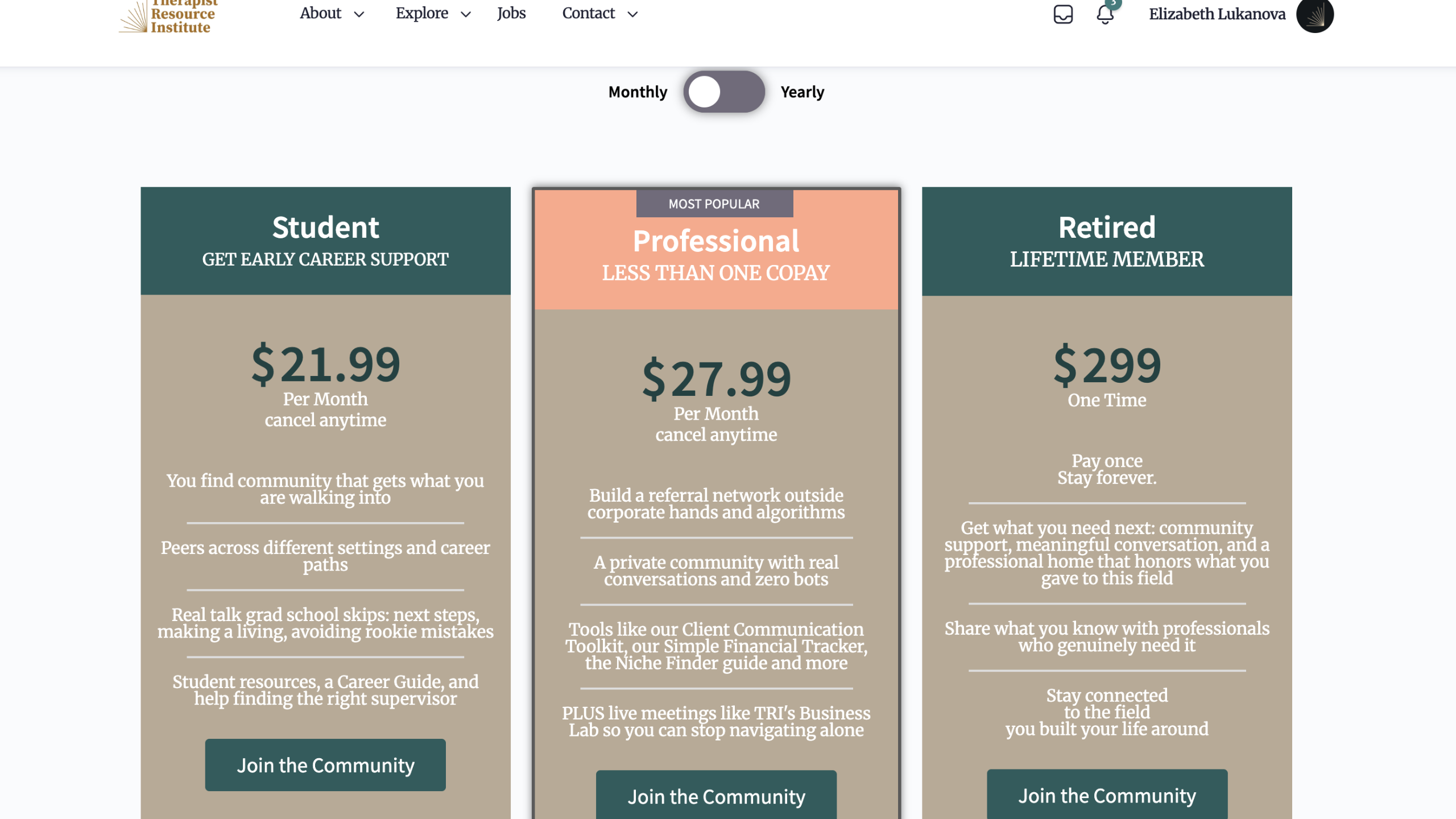
Therapist Resource Institute (TRI) is a membership community for licensed therapists in the United States. Sharon Harper built it, and its value rests on having a community of actively practicing therapists inside. The membership has a tier for each stage of a therapist's career: Student for people still training, Professional for therapists in practice, and a lifetime tier for retired therapists.
That last tier reflects something Sharon understands about her own field. Therapists retire every year, and each one leaves behind clients who still need care. Someone closing a practice has to place those people somewhere, and a community of practicing colleagues across the country is exactly where. Paying once for permanent access to that community makes sense for a therapist at the end of a career.
The Problem
TRI's initial launch in January brought in almost 40 paid members. Growth continued slowly afterward, as expected for a new membership community. But the Referral Desk, one part of TRI, depended on having enough therapists interacting.
The Referral Desk is a directory where therapists pass on clients. When a member can't take on a client, they search it for a colleague who can and send that colleague a referral. Every referral needs two therapists: one with a client to pass on and one able to take them. But only paying members could use the Desk, so it could only grow as fast as paid membership did.
Sharon wanted to expand participation so more therapists could find someone appropriate for a referral and make the membership feel worth it for those paying. For a paying member, more therapists using the Desk means more chances to receive a referral.
The Decision
The freemium idea was Sharon's, and she brought it to MemberFix already formed.
What makes it work is how narrow it is. The Referral Desk serves one situation: a therapist is fully booked, or cannot take a client for some other reason, and wants to pass that person to a colleague who can. A free account lets a therapist send that referral. Receiving referrals stays on the paid plans, along with everything else, down to editing your own profile or seeing another therapist's full details.
The question for MemberFix was how to build it. We kept it inside what Sharon already had, with no new plugins and no new plugin subscriptions.
What We Built
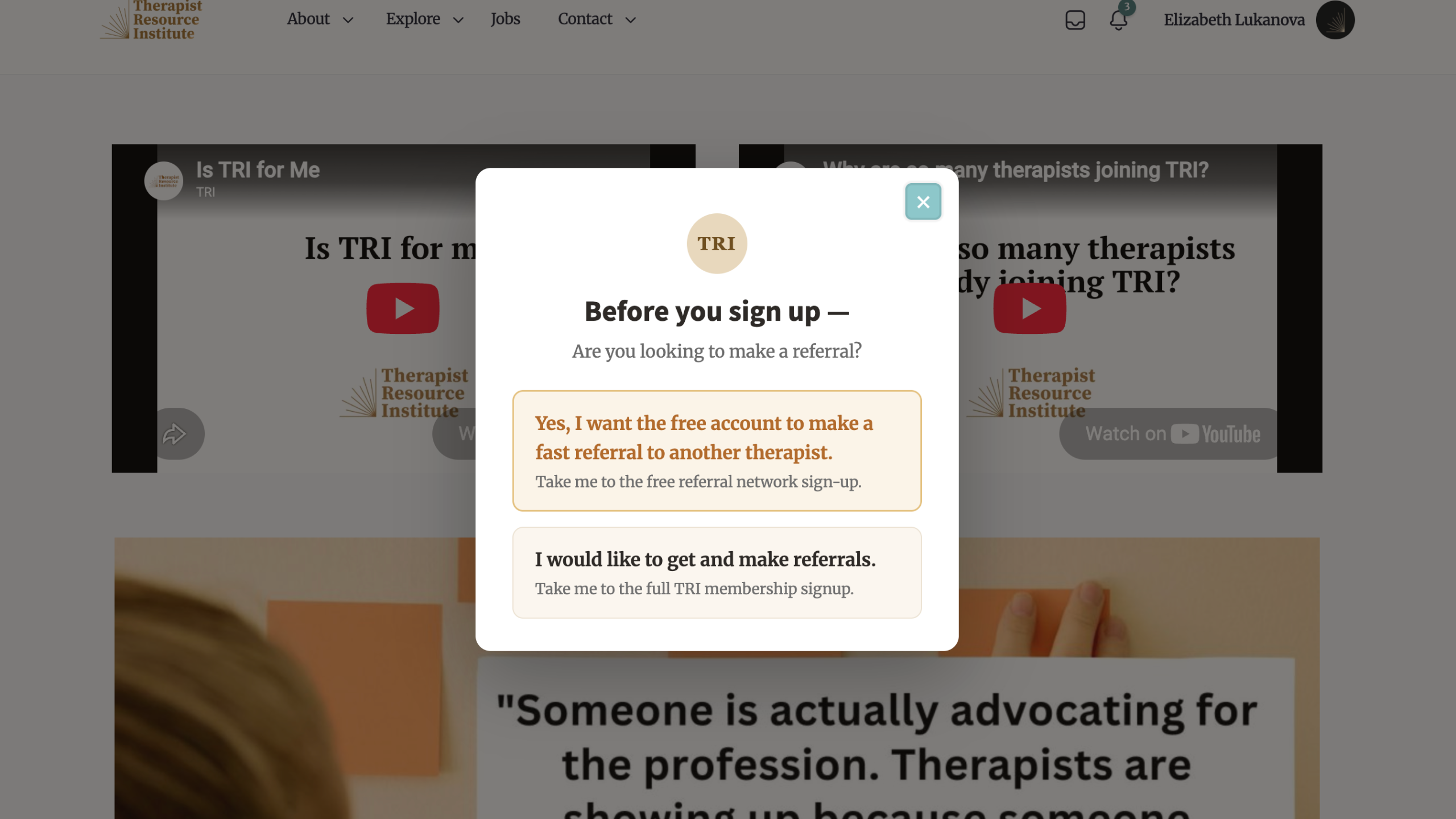
A question before the pricing page. Visitors are asked whether they are looking to make a referral. “Yes” takes them to a free account. The alternative, “I would like to get and make referrals”, takes them to full membership.
One thing, included. A free member can search the therapist directory and send a referral. Receiving referrals, like everything else, stays on the paid plans.
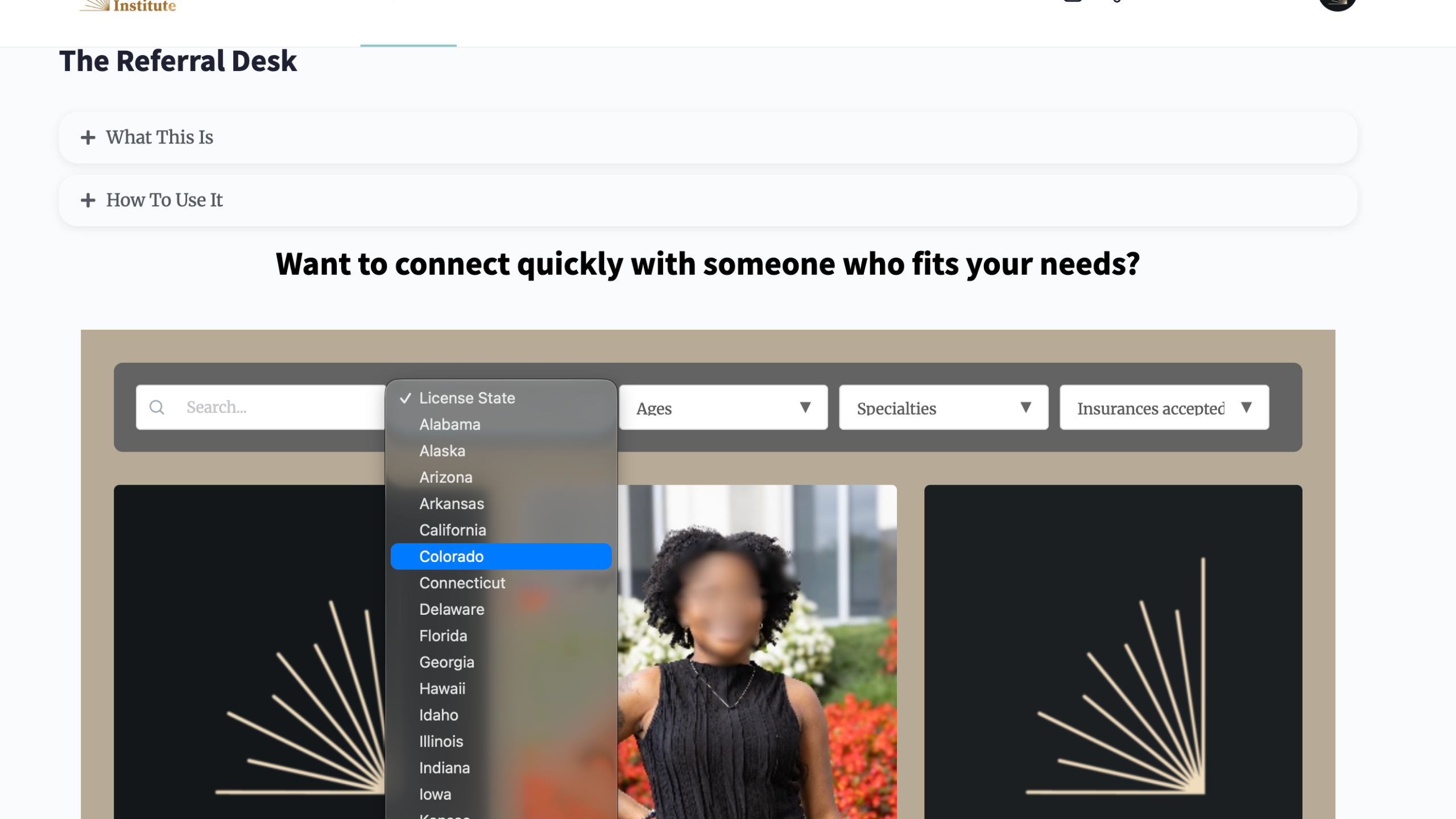
Two ways to refer. The directory filters by license state, client ages, specialty and insurances accepted. From a colleague's profile, a therapist can either hand off directly with no call needed, or ask for a short fit call and offer their availability across the week.
No client details in the system. The rules around therapist practice are strict, and the referral forms don't ask for any information about the client. Both paths require the sender to confirm the referral contains no client-identifying information before anything sends. What travels between two therapists is the fact that a referral exists and a way to make contact.
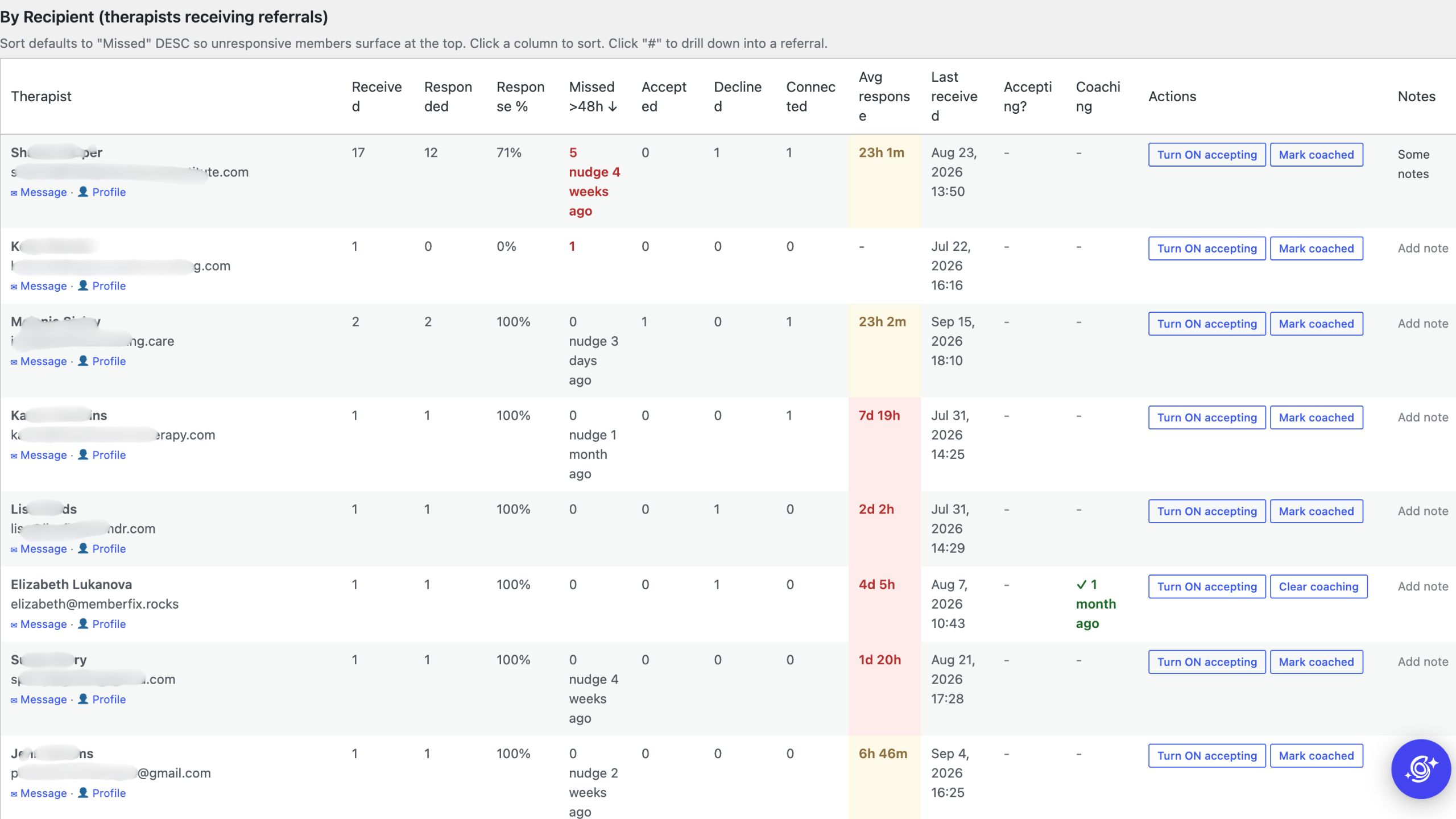
A referraldashboard. Sharon can see every referral, who received it, who replied and how long they took. Unanswered referrals sort to the top, so she can follow up with members who are not responding. We built it so Sharon could see what was happening on her own platform in a convenient way.
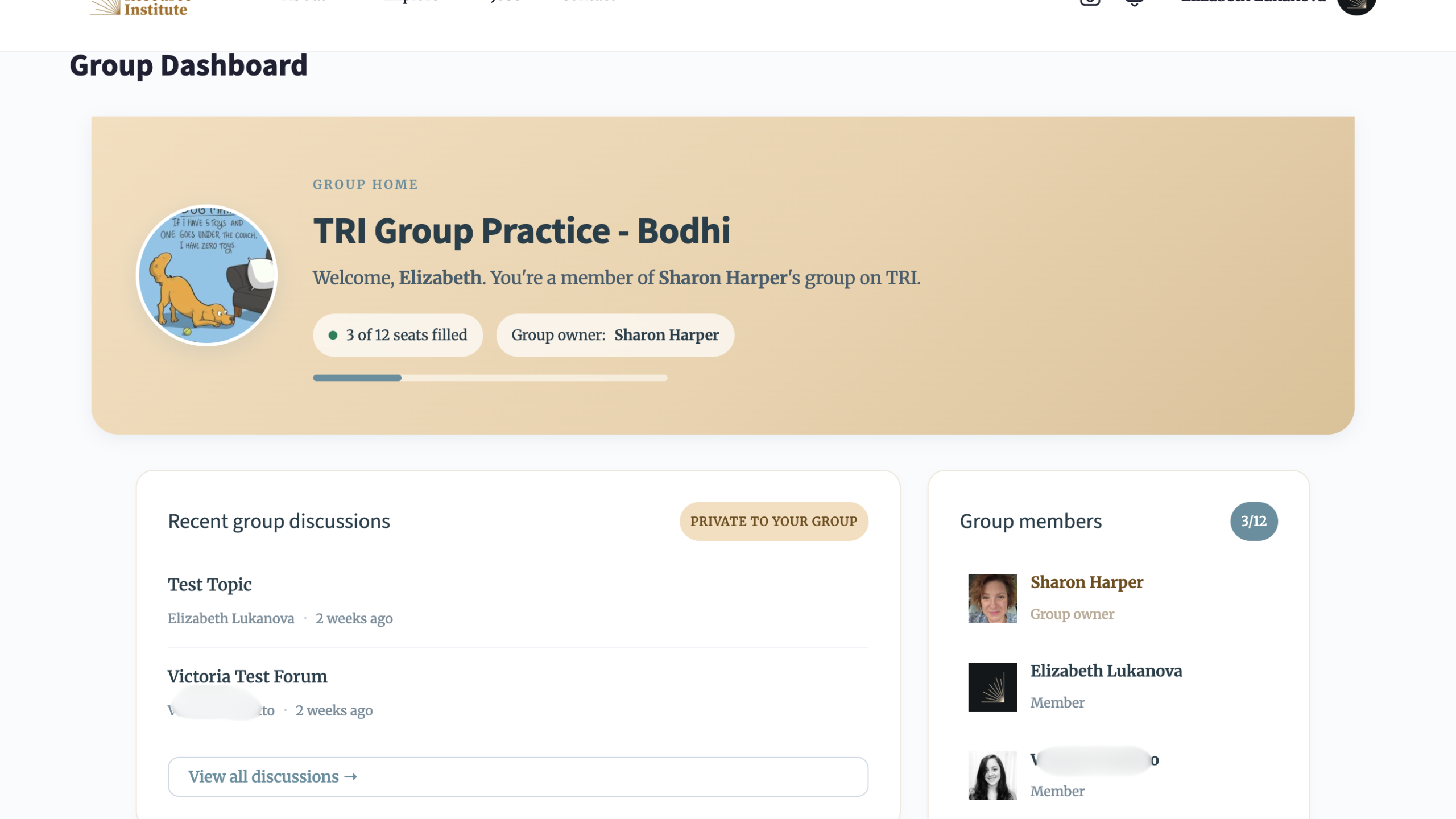
A group plan. When Sharon was asked about a group plan, she brought it to MemberFix, and we immediately developed the setup so the practice could purchase an annual subscription and manage memberships for its clinicians. We also created a private room for the group that the group practice owner can manage.
The build took a month, with Sharon and our team testing the flow together daily. Nothing new was added to the stack to run any of it.
The Results
In the six weeks after the free tier launched:
Around 40 therapists registered free accounts, with no advertising behind it. Only newsletters, live sessions and word of mouth. Each of them can now send referrals to paying members.
Three have moved onto paid plans.
The first group subscription sold, bringing 12 people from one practice onto the platform.
“I wanted to open the Referral Desk to therapists who weren't paid members to expand participation and create more potential referrals for paying members. MemberFix worked closely with me to make it happen. The developer also responded quickly when a group practice asked for a membership option for its clinicians, something we didn't have yet!
The free tier does not appear to have detracted from continued paid membership growth and instead gives people another reason to take a look at TRI.”
– Sharon Harper, Founder, Therapist Resource Institute
The Takeaway
TRI's free tier works because of what free members do once they're in. The membership is worth more when more therapists take part. Free members can do one thing: send a referral. Each referral can bring a client to a paying member. Receiving referrals, editing their own profile and seeing colleagues' full details all stay on the paid plans.
The same approach can work for any membership where members get value from each other, through a directory, referrals, introductions or a marketplace. Ask what a non-paying person could do on your site that would make it better for the people who pay. Open that one thing up, and keep the rest paid.
A request for a plan you don't sell yet is worth taking seriously. A group practice asked TRI for a team option, and TRI has already sold its first group subscription.
The free tier and the group plan both run on the MemberPress and BuddyBoss setup TRI already had. A feature your platform lacks can often be built into the site you already run. We did the same for another BuddyBoss community.
Common questions about freemium membership sites
Does a free tier hurt paid membership sales?
It can if it gives too much away. Therapist Resource Institute's free account unlocks one thing: searching the directory and sending a referral. Editing your own profile and seeing another therapist's full details stay on the paid plans. Six weeks in, Sharon's read is that it doesn't appear to have slowed paid membership growth.
Can you add a freemium tier without new plugins?
Here, yes. It was built on the MemberPress and BuddyBoss setup already in place, with no new plugins and no new subscriptions.
How long did the build take?
About a month, with the founder and our developer testing the flow together every day.
What did the freemium tier bring in?
In the six weeks after launch, around 40 therapists registered free accounts with no advertising behind it, three moved onto paid plans, and the first group subscription sold.
Have an idea for your membership site? Let's talk about building it.
Reviewed by Vic Dorfman, founder of MemberFix, a WordPress membership expert with 10+ years building, fixing, and scaling membership sites. Last reviewed November 2026.
WordPress based membership sites have certain requirements, and make use of certain applications that, in my experience, makes most of the popular hosting providers a poor choice.
Ask a membership owner why people cancel and you get the usual list. Too busy. Too expensive. They didn’t do the work. Nathalie Dorémieux has helped build over 300 membership
To provide the best experiences, we use technologies like cookies to store and/or access device information. Consenting to these technologies will allow us to process data such as browsing behavior or unique IDs on this site. Not consenting or withdrawing consent, may adversely affect certain features and functions.
Functional
Always active
The technical storage or access is strictly necessary for the legitimate purpose of enabling the use of a specific service explicitly requested by the subscriber or user, or for the sole purpose of carrying out the transmission of a communication over an electronic communications network.
Preferences
The technical storage or access is necessary for the legitimate purpose of storing preferences that are not requested by the subscriber or user.
Statistics
The technical storage or access that is used exclusively for statistical purposes.The technical storage or access that is used exclusively for anonymous statistical purposes. Without a subpoena, voluntary compliance on the part of your Internet Service Provider, or additional records from a third party, information stored or retrieved for this purpose alone cannot usually be used to identify you.
Marketing
The technical storage or access is required to create user profiles to send advertising, or to track the user on a website or across several websites for similar marketing purposes.



 Reviewed by Vic Dorfman, founder of MemberFix, a WordPress membership expert with 10+ years building, fixing, and scaling membership sites.