



Jen Santos had a decade of event tech experience and watched most of it disappear overnight.
The pandemic didn't just pause the events industry. It displaced the people who knew how to run it. When organizations started putting on events again, the institutional knowledge that used to pass from veteran to newcomer was simply gone. Teams were assembling without anyone who understood the tools they were supposed to use.
So Jen built a training platform. Not a certification path for 15-year veterans. A foundation for people entering the industry who don't know what they don't know – in a space where no standardized training existed.
If you're building an online training platform or professional course – whether for event tech, compliance, finance, or any other niche – Smart Event Academy offers a practical case study in course architecture, LMS decisions, and what it actually takes to turn a training product into recurring B2B revenue.

The Mission: Train the People Around the Tech
The problem Jen set out to solve isn't obvious. Events don't usually fail because of bad software. They fail because teams don't know how to use the software – or more precisely, they don't know the right questions to ask before they're already in trouble.
Event technology has no standardized language. Every organization does things roughly the same way, but not quite. Someone stepping into an event tech role at a smaller organization often inherits it by default – no specialist budget, no training, and no obvious place to learn. They rely on what the previous person knew, which was usually passed down the same way.
Jen's course addresses both the technical foundation – what phases a typical event goes through, what tools do what – and the alignment layer: how to get a team asking the right questions before problems compound.
This is a useful frame for anyone designing a training product. The most valuable thing you can often teach isn't the technical knowledge itself. It's the judgment to apply it correctly, and the shared language that lets a team do that together.
The Mistake: Trying to Make LearnDash Bend to Your Will
Jen started on WordPress with LearnDash. She's technically capable and comfortable figuring things out. The problem wasn't confidence. It was complexity by accumulation.
LearnDash alone wasn't enough for what she needed. She added BuddyBoss. Then Uncanny Owl. Three subscriptions, three plugin ecosystems, three places things could break. Every change required bringing her developer back in – and getting on their schedule meant waiting a month, sometimes longer. By the time a change went through, it often wasn't quite what she'd asked for.
The real issue wasn't the platform – it was the support model. LearnDash on WordPress is a capable setup. But without someone dedicated to managing it, every change became a dependency on a developer who had other clients and other priorities.
When she switched to LearnWorlds – a hosted LMS – her platform costs dropped by roughly 75%. More importantly, she stopped fighting the tool. Her approach now: build within what the platform does well, rather than engineering around its edges.
For anyone choosing an LMS: the real cost of plugin dependency and developer availability doesn't show up in a comparison chart. It shows up in the months you spend waiting for fixes that shouldn't have been needed in the first place. If you're weighing LMS options for a WordPress-based platform, MemberFix has a resource library covering this in detail.
The Design Choice: Build the Full Course First, Then Splinter
Most course creation advice says: start small, validate a module, test before you build everything.
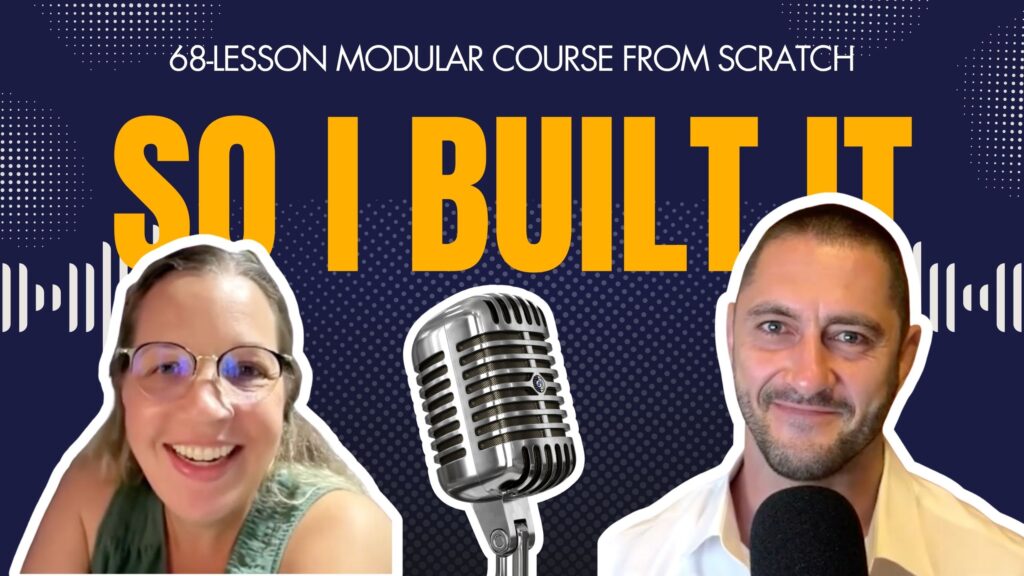
Jen did it the other way around. She built all 68 lessons before creating any mini courses – deliberately, and knowing it was unconventional.
Her reasoning: she was worried about losing the through-line. Building modules in isolation meant she wouldn't be able to see how the program held together as a whole. She needed the complete structure before she could cut it into pieces that made sense independently.
The result: she now has real client feedback driving the splinter strategy. Corporate agency clients started asking for specific topic areas. Mini courses. A lower-priced entry point that upsells to the full program. She knows which pieces the market wants because she built the full map first and let clients tell her where they actually wanted to go.
If she'd started with mini courses, she'd have been guessing. Instead, she sold the full program, got real feedback from real buyers, and is now building the narrower products from a position of evidence.
The conventional advice – start small and validate – works well for many products. For a training program that needs structural coherence, building the full thing first may produce a better product and a clearer roadmap for what comes next.
The Validation: When Events Work for Membership Organizations
One conversation in the episode stands out for membership site owners and association managers: when does hosting an event actually make sense?
Jen's answer is direct. You need an engaged audience before you need an event strategy. Not a large mailing list – an engaged one. The distinction matters because engagement is what converts. Raw follower counts don't move tickets.
The failure mode she describes is common: sending an invitation to 5,000 people and getting three responses. That's not a marketing problem. It's an audience readiness problem.
She also draws a clear line between event formats. Training events – a clear educational outcome, something attendees can use – work. Summit formats that borrow audiences from other creators generally don't. The borrowed-audience model looks efficient on paper, but tends to produce low-commitment attendees, higher costs, and sometimes alienated audiences on both sides.
For membership organizations: if events are part of your strategy, the best investment is community engagement first. The event is a product of the relationship, not the start of one.
What It Takes to Build a Training Platform That Lasts
Jen runs Smart Event Academy as a three-person operation – a video editor, a LearnWorlds configuration specialist, and her. Lean by design, with each role filling a gap she was honest about not being able to fill herself.
A few things worth noting from how she built it:
Modular from the start. The 68-lesson course was recorded so that individual modules can be dropped in and out without rebuilding around them. When client feedback arrives and the program needs to evolve, the architecture supports that. This wasn't accidental – she worked to build it that way before she had clients asking for changes.
The tool works for the business, not the reverse. Switching to LearnWorlds was a decision to accept certain constraints in exchange for stability and simplicity. She stopped trying to bend the platform and started building within what it does well. That's a different posture than most WordPress operators start with – and it took a painful detour through plugin overload to get there.
Recurring relationships come from feedback loops. Her agency clients buy seat packages. The retention mechanism isn't automatic renewal – it's a review and feedback process. She asks what worked, what they want more of, whether they need more seats. The platform evolves in response. Clients stay because the product keeps improving around their specific needs.
Build the whole thing before you slice it. Conventional advice favors starting small. For a training program where coherence matters – where later lessons build on earlier ones and the whole thing needs to flow – building complete before splintering may produce a better product and a clearer picture of what your audience actually needs.
The event tech training market is small and specialized. There is almost no formal education pipeline for newcomers entering the industry. Jen built the thing that didn't exist. In most professional niches, that opportunity is still available – if you're willing to build the foundation before the market tells you it's worth building.
Learn more about Jen Santos and Smart Event Academy at https://smarteventacademy.com/
About MemberFix Radio:
We interview experts and share insights for membership site owners and subscription business leaders building sustainable, profitable recurring revenue models.
Running a WordPress membership or eLearning site?
MemberFix provides managed WordPress operations for membership, eLearning, and community platforms — so your team never has to worry about the tech breaking during a launch or losing members to site issues. We handle development, support, updates, and monitoring with SLA-backed guarantees. Trusted by industry leaders like Echelon Front, TechServe Alliance, and hundreds of others since 2014.
Book a free ops assessment at https://memberfix.rocks/contact